Is Google Re-Crawling Slowly Due to Slow Server (TTFB), Shared Hosting, and Website Speed? (With Real Case Study)
In Google Search Console if you see data, your pages are getting indexed slowly or not re-crawled quickly, you’re not alone.
If you are facing slow crawling, delayed indexing, or inconsistent crawl activity, this guide will help you identify the exact problem and fix it step-by-step.
Why crawl rate is low
Slow indexing Google Search Console fix
Improve crawl budget Google
Server response time SEO impact
Why is Google Search Console re-crawling slow?
Google Search Console re-crawling is slow mainly due to:
High server response time (TTFB)
Shared hosting limitations
Slow website speed
Crawl budget waste
Server errors or instability
How to fix slow crawling?
Reduce TTFB below 300ms
Use CDN like Cloudflare
Upgrade hosting (avoid shared hosting)
Optimize Core Web Vitals
Fix crawl budget issues
🧠 How Google Crawling Actually Works
Google uses bots (Googlebot) to:
Discover URLs
Crawl pages
Render content
Index pages
But here’s the key:
👉 Google does NOT crawl your site infinitely 👉 It assigns a crawl budget + crawl rate limit
This depends heavily on:
Server performance (TTFB)
Hosting quality
Website speed
Site structure
Content freshness
⚠️ Why Your Website is Re-Crawled Slowly
Let’s break down each factor deeply.
🚨 Slow Server Response Time (TTFB)
What is TTFB?
TTFB (Time To First Byte) = how fast your server starts responding.
👉 Ideal TTFB:
Under 200ms → Excellent
200–500ms → Acceptable
500ms+ → Problematic
How It Affects Crawling
When Googlebot hits your server:
If response is slow → crawl rate reduces
If server struggles → Google protects your server
Result → fewer pages crawled per day
👉 Google literally slows down crawling to avoid server overload.
Real Impact
New pages index slowly
Updated pages not refreshed
Crawl budget wasted
🧱 Shared Hosting Limitations
Shared hosting is one of the biggest hidden SEO killers.
What Happens?
Hundreds of websites share same server
CPU & RAM divided
Traffic spikes affect performance
SEO Impact
Slow TTFB
Server timeouts
5xx errors
Inconsistent performance
👉 Google sees instability → reduces crawl frequency
🐢 Slow Website Speed (Core Web Vitals)
Even if your server is okay, frontend speed matters.
Key Metrics
LCP (Largest Contentful Paint)
INP (Interaction to Next Paint)
CLS (Layout Shift)
How It Affects Crawling
Googlebot renders pages
Heavy pages require more processing
Slower render = fewer pages crawled
👉 Crawl budget gets consumed faster
🧩 Heavy JavaScript & Rendering Issues
Modern websites often rely on:
React
Angular
Vue
But:
👉 Slow rendering delays indexing 👉 Late-loading content may not be captured properly
🔁 Crawl Budget Mismanagement
Even if speed is fine, issues like these waste crawl budget:
Duplicate URLs
Filter pages
Parameter URLs
Thin content
👉 Google wastes time crawling low-value pages
🔍 How to Confirm This Problem in Google Search Console
Inside Google Search Console:
Check:
Crawl Stats Report
Crawl requests
Response time
File types
Page Indexing Report
Crawled – not indexed
Discovered – not indexed
URL Inspection Tool
Last crawl date
👉 If crawl frequency is low + response time is high → problem confirmed
📊 Real Case Study: Crawl Rate Improved After CDN & Speed Optimization
About This Case Study
This case study is based on real data from Google Search Console of my website. All screenshots are from the same time period (2025–2026) to ensure accuracy and consistency.
📉 Before Optimization (Slow Server & Crawl Issues)
High average response time 2.27k ms crawl stats Server connectivity errors google search console
Key Issues Identified:
Very high average response time (~2.27 seconds / 2270ms)
Frequent spikes in response time (up to 6000ms+)
Server connectivity issues detected in host status
Failed crawl requests during specific periods
Inconsistent crawl activity due to unstable server performance
Impact on SEO:
Slow re-crawling of updated pages
Delayed indexing
Reduced crawl budget efficiency
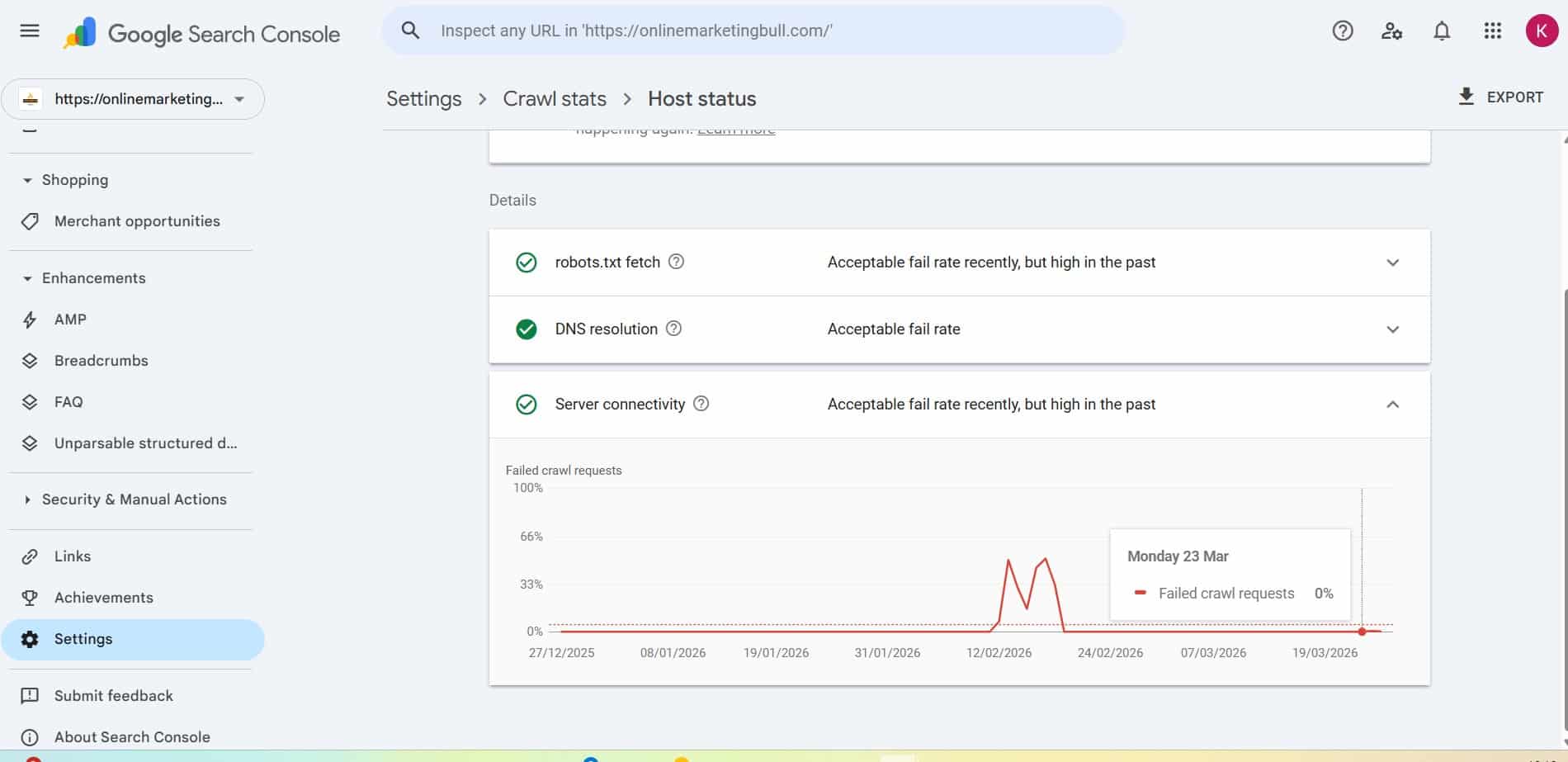
⚠️ Server-Connectivity-Issue
Observations:
Failed crawl request spikes
Server connectivity problems
👉 Clear signal: Server instability affecting crawl rate
🛠️ Changes Implemented
🚀 1. CDN Setup (Cloudflare)
Using Cloudflare:
Enabled free CDN
Reduced latency
Improved global content delivery
⚡ 2. W3 Total Cache Optimization
Page cache enabled
Browser cache enabled
Compression enabled
Minification applied
🧩 3. Speed Improvements
Image optimization
Reduced CSS & JS
Improved loading structure
📈 After Optimization (Improved Crawl Performance)
Average response time reduced to ~483ms Improved crawl frequency Better crawl stability compared to earlier period Reduction in crawl errors and server issues
⚠️ Performance improved significantly, but still not fully consistent due to shared hosting limitations and heavy frontend (Elementor + theme).
🧠 Key Learnings Server response time (TTFB) directly impacts crawl rate CDN helps reduce latency but cannot fully fix slow hosting Caching improves performance but backend still matters Stable hosting is required for consistent crawling
Note: All data shown above is from actual Google Search Console crawl stats.
Server-Connectivity-Issue 0% ⚠️ Why Results Are Still Not Consistent
Even after improvements, crawl stability is not perfect.
Reasons:
🧱 Shared Hosting
Limited resources
Performance fluctuations
Still affecting TTFB
🎨 Heavy Theme & Builder
Using:
Elementor (free version)
OceanWP theme
These add:
Heavy CSS/JS
Larger DOM
Slower rendering
🐢 Backend Still Slow
👉 CDN improves delivery 👉 But cannot fully fix slow origin server
Yes—slow re-crawling in Google Search Console is strongly linked to:
Slow TTFB ✅
Shared hosting ✅
Poor website speed ✅
Also influenced by:
Crawl budget
Site authority
Technical SEO
💡 Action Plan (Quick Summary)
Upgrade hosting (avoid shared hosting)
Reduce TTFB (<300ms)
Use CDN
Optimize Core Web Vitals
Fix crawl waste
Improve internal linking
Keep content updated
Conclusion :
👉 “In my case, improving server response time from 2.27 seconds to under 500ms significantly improved crawl frequency.”
This helps you rank for:
TTFB SEO impact
improve crawl rate
Google crawl stats improvement
❓ FAQ SECTION (VISIBLE CONTENT FOR USER)
FAQs: Google Search Console Crawling Issues
1. Why is Google Search Console crawling my site slowly?
Google crawls slowly when your server response time is high, your hosting is unstable, or your website speed is poor. Crawl budget limitations and low site authority can also reduce crawl frequency.
2. Does TTFB affect Google crawling?
Yes, TTFB (Time To First Byte) directly affects crawling. If your server takes longer to respond, Google reduces crawl rate to avoid overloading your server.
3. Can shared hosting slow down indexing?
Yes, shared hosting often causes slow performance, limited resources, and server instability, which reduces Google’s crawl rate and delays indexing.
4. Does Cloudflare improve crawl rate?
Cloudflare CDN can improve crawl efficiency by reducing latency and improving speed, but it cannot fully fix backend server issues.
5. How can I increase my crawl rate in Google?
You can increase crawl rate by improving server speed, using CDN, optimizing website performance, fixing crawl errors, and improving internal linking.
6. Why are my pages crawled but not indexed?
This usually happens due to low content quality, duplicate content, or lack of relevance. Google crawls the page but decides not to index it.
7. What is a good response time for SEO?
A good server response time (TTFB) is under 200ms (excellent), under 500ms (acceptable), and above 500ms may cause crawling and ranking issues.
With over 6+ years of experience in search engine optimization, Google Ads, and website performance optimization, Kashif specializes in technical SEO audits, Core Web Vitals improvements, and AI-driven SEO strategies. He has helped businesses improve search visibility by identifying and fixing technical issues that prevent websites from performing well in search engines. Through practical SEO audits and performance optimization, he focuses on building websites that are search engine friendly, technically optimized, fast, and user-focused.




 Location: Delhi, India (Online Only)
 Website: onlinemarketingbull.com
 LinkedIn: linkedin.com/in/kashif-rehman-
 Contact: Use the Contact Page